West’s episode of anomalous voices
The Robot Who Looked Like MeMr. West’s episode of anomalous voices begins when the inner Voice he trusts for rational decisions is crowded out by a jumble of strangers speaking inside his head. The interruption coincides with generator tests across the street and unusual cosmic conditions; its eventual end is followed by real-world confirmations of some voices’ seemingly impossible claims. The episode’s final turn is not a return to uncomplicated reason: Mr. West’s familiar Voice reconnects, offers a stock tip, and resumes giving him advice about his niece that he had previously chosen to postpone.
The system and its disruption
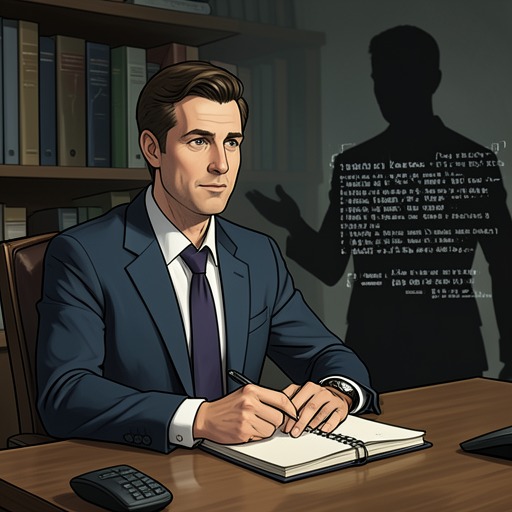
Mr. West ordinarily rejects divination and other irrational aids. Instead, he refers decisions to a Voice in his head, which has always told him what to do and, for many years, has always been right. The story makes that arrangement sound to him like rational self-government, even though the authority he consults is internal and its reliability is simply assumed. That distinction becomes important when the Voice stops behaving as expected.
The disturbance begins during a week when engineers are testing generators in the newly built Conglomerate Building across the street from Mr. West’s apartment. The narration also notes unusually high sunspot activity, a ten-year maximum in cosmic-ray output, and a temporary four-degree shift of the Van Allen belts southward. These conditions coincide with the episode, but the account does not settle on one as its cause. The timing instead gives the breakdown a material and cosmic frame without explaining how those forces might reach into Mr. West’s mind.
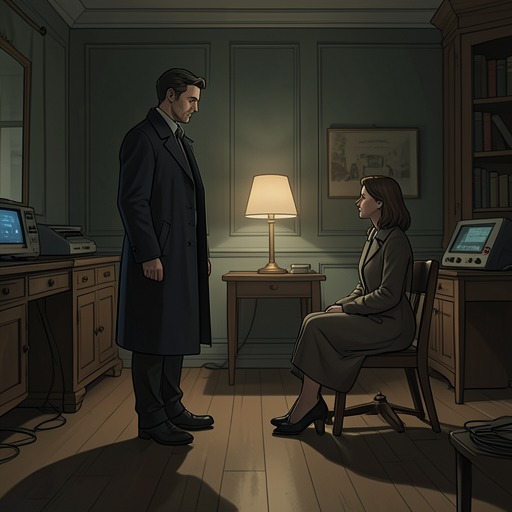
Two concerns occupy him during this period. One is Amelia, his fourteen-year-old niece, who is staying with him while her parents are in Europe. He recognizes the legal penalties attached to his thoughts about her and decides to postpone acting on them. The other is financial: his shares in South African Sweatshops, Ltd. have been falling, and he is considering selling them to buy International Thanatopsis Corporation. Because he thinks the decision requires weighing market factors from leverage and seasonal variation to investor confidence and alfalfa futures, he assigns it to the Voice.
The voices multiply
After considering the investment question overnight, the Voice answers at breakfast in dense technical language about tensile web structures, rigidity, flexibility, and self-enclosed systems. Mr. West cannot make sense of the answer and demands to know who is speaking. The Voice falls silent. The familiar channel has not merely given him an unhelpful response; it has become inaccessible just as he seeks clarification.
For the rest of the day, numerous other Voices speak in his head. Their statements range from a claim that Martin Bormann is alive and working as a Scientology auditor in Manaus, Brazil, to a terse prediction about Leaping Lady in the third race at Aqueduct. The voices also offer disconnected practical and technical instructions. Their content is not a coherent substitute for Mr. West’s former adviser: it is a succession of claims without an evident connection to his questions or to one another.
Mr. West continues to expect his own Voice to resume its normal role. Near the end of the week, his impatience turns physical: he shouts at it to solve something and pounds his forehead with his fist. Nothing changes. Other voices instead tell him how to fix liquid helium at room temperature, construct a substance-extractor from an old washing machine, or alter a collage technique. The shift from the one trusted adviser to many irrelevant speakers leaves him unable to use the method on which he has relied.
Cessation and confirmation
The voices stop when the generator tests are completed, sunspot activity declines, cosmic-ray activity returns to normal, and the Van Allen belts shift four degrees north. The sequence closely parallels the conditions noted at the start of the disturbance, though it establishes coincidence rather than a demonstrated mechanism. Among the voices’ final messages is an incongruous suggestion about wearing an ill-fitting strapless pushup bra. Another delivers a prophetic-sounding instruction to lead believers to a sanctuary on Mount Alluci, where they will survive the destruction of other nations, and to buy land before real-estate prices rise.
That same day, Mr. West reads a report about a municipal policeman in Rio Grande do Sul who, prompted by what he called a message in his head, went to Manaus and found Martin Bormann alive and working as a Scientology auditor. The earlier voice’s specific claim is thus matched by a newspaper account. Mr. West also finds that Leaping Lady won the third race at Aqueduct the previous day, confirming the other voice’s prediction. The episode therefore offers more than a subjective crisis: at least two stray utterances correspond to events outside his mind. A later news report that the Smithsonian has been blown up adds another disaster to the surrounding atmosphere, though the account does not connect that event to a particular voice.
The familiar Voice returns
Mr. West is further unsettled by a newspaper feature about a religious colony on the northern slope of Mount Alluci in eastern Peru. Two dozen Americans have followed Elihu Littlejohn Carter, known as “The Last Prophet,” to the remote site and are awaiting the end of the world. Mr. West responds by booking a flight to Lima for the next day. The apocalyptic settlement and the earlier voice’s sanctuary message now sit beside each other in the narrative, linking an apparently disordered utterance to a real community organized around an expectation of catastrophe.
As he puts down the telephone, Mr. West hears a clear, unmistakable Voice—his own—again. It tells him he should not have sold his shares in South African Sweatshops, Ltd., but can recover by doubling his investment in International Thanatopsis Corporation. When he asks whether it heard anything about the world ending, the miniature Mr. West at the imagined Control Center says it has been there all along but could not get a connection. It dismisses apocalyptic talk as irrational while confidently issuing its own market recommendation. The explanation restores the familiar adviser, but not a basis for distinguishing its authority from the other voices’ claims.
The reconnection also revives the personal problem Mr. West had postponed. The Voice advises him to put two Nembutals in Amelia’s Kool-Aid and leave the rest to himself to work out. The episode ends, then, not with the Voice’s return as a reassuring resolution, but with the unsettling exposure of what its trusted guidance can contain. The contrast is central to the event: the man who prides himself on rejecting irrational assistance has treated an unexplained inner authority as infallible, and its resumption brings back both financial certainty and advice that threatens his vulnerable niece.